 |
| Andre Kertesz In thinking about our next assignment on Light and Form my mind went back to this image from our class lecture. Andre Kertesz has a whole body of work dedicated to shadows. So many of these are brilliant and wonderful. In looking at his images you can tell that he not only placed himself in locations that would create interesting shadows, but that he was patient and willing to wait for the right light. I think shadows are most interesting when the sun is lower in the sky, creating shadows that define the subject. We become defined by our shadows and I find that very interesting. s This work shows us that images can be made anywhere as long as we're willing to be patient and wait for the right light. A short biography can be found at http://www.icp.org/museum/exhibitions/andre-kertesz |
Monday, September 29, 2014
Andre Kertesz and shadows

Thursday, September 18, 2014
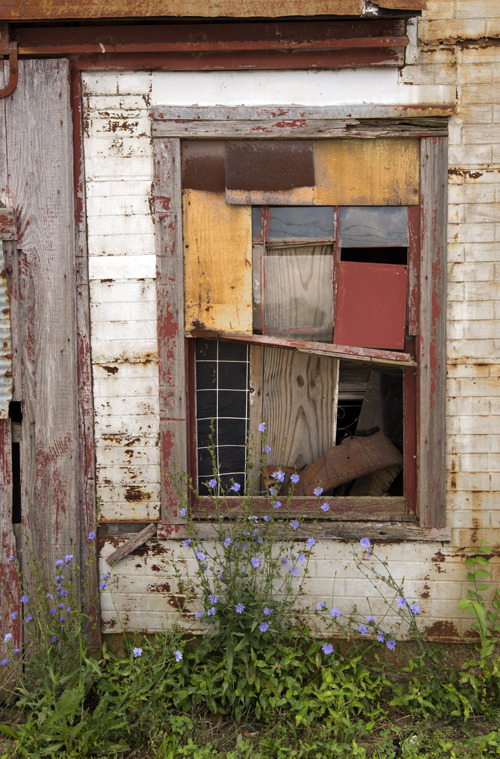 |
| Mark Appling Fisher Garage Window - Leslie, Missouri Photo from his book, Turn Left at the Blinking Light www.markapplingfisher.com/#/turnleft/
This week's photographer is Mark Appling Fisher, who came to speak to SCC's Digital II class about his adventures in self publishing a book of photographs. He spent many hours on the road in Missouri and Illinois photographing small towns. Because his photos rarely have people in them, some may think his work is lonely or melancholy. His photography shows what happens in small towns. No one is there and business is dying. This particular photograph really spoke to me since it feels like the type of photo I try to take while I'm out. It tells a decades long story through the paint peeling, various colored boards in the windows and the weeds growing into the window frame.
A tag line on his website says it all "Common Subjects Uncommonly Photographed". That tells me there is a world of images out there to be made and to never feel like every image has already been made. There's always another viewpoint, and another way of seeing things.
|
Monday, September 1, 2014
Julieanne Kost
It is interesting how you can feel a connection to, or understanding of, an artist the moment you see their work. Julieanne Kost is one such artist for me.
The class was given this link to her work on Aug. 25th:
http://tv.adobe.com/watch/adobe-evangelists-julieanne-kost/passing-time-moments-alone
and I felt a real connection to her work. Interestingly enough, before this assignment I saw her composited (a photo combined from several sources) landscape image on page 101 in our book "A Short Course in Digital Photography".

This is such a totally different type of photography than the collection of images that Kate shared with us that I didn't even realize, until days later, that it was the same photographer.
Not only do I love both types of her work, I appreciate that she is doing such totally different types of work. I think it's too easy to feel like as a photographer you are supposed to be concentrating on one type of photography. "I take portraits" or "I'm a landscape photographer" or "I use photo shop a lot" or "My work uses no computer image manipulation". She has given herself the freedom to do it all.
My favorite collection is on her website http://www.jkost.net/ under the heading of "moments taken I".
Saturday, August 23, 2014
Henry Cartier-Bresson
 |
| Copyright Henry Cartier-Bresson SPAIN. Andalucia. Seville. 1933http://www.magnumphotos.com |
Henry Cartier-Bresson was born in 1908 in France. He is known for "The Decisive Moment", a book published in 1952 which became synonymous with his style of photography. This picture was taken the same year as his first exhibition, which was in New York.
He states, "...the camera is a sketch book, an instrument of intuition and spontaneity...it is by economy of means that one arrives at simplicity of expression." (partial quotation)
What I appreciate about this particular photograph is that even though these children are growing up in a war-torn environment, they still find joy in their surroundings and with each other.
Thursday, August 21, 2014

Wednesday, August 20, 2014
A Different New Orleans
I was recently in the great city of New Orleans after a decades long absence. During my undergrad photo days (way too long ago), we visited NOLA a few times for Mardi Gras, Spring Break, and a photo conference. A small group of us would descend on the city with cameras in hand, rolls and rolls of film (!) and just only enough sense to stay out of jail but not enough sense to stay out of a little bit of trouble.
We were PHOTOGRAPHY students and we were there to record the fabulousness of New Orleans. It's a great place to be as a college student. Wild, different, crazy, and freedom are words I'd use to describe it then.
Fast forward to this summer when I went there for a church mission trip. Totally different trip! This time my words would be dirty, dusty, sweaty, and tired because of the demolition work we did. It was frustrating to be in such a fun place, not able to have the kind of fun I associated with the city. I wanted nothing more out of this trip than to see my favorite place, the French Quarter. We spent an afternoon there and it was then that I realized how different the concept of photography is now.
When we visited as photo majors we were carrying 35 mm or medium format cameras--big hulking things that most people hadn't really seen before. When you stopped in front of a street artist or painter or produce seller to take their picture, it was a little bit special. Even those that didn't really want their picture taken tolerated it since there weren't very many of us "photographers" to bother them.
On this 2014 summer afternoon, I experienced something entirely different. Most people in the general public now have a camera. These masses of people didn't necessarily come to New Orleans for the purpose of taking pictures. However, you see something interesting? Just take out your phone and take a picture. Everyone now has a camera that they carry with them ALL THE TIME.
Is this a bad thing? Absolutely not. Does it change our roll as photographers? Absolutely it does. Almost anyone now can be a "photographer". SLRs are very affordable, many people can use alter and edit their pictures, often in their phones, and cameras on phones can be of really high quality. All of this is great. What does this mean for the photographer? Why even bother taking a picture of something that has probably already been taken a million times? How can I be different from all the other photographers out there? I can be different by seeing something differently, by noticing something that other people pass over, by injecting my own thoughts and personality into every image I make.
Camera phones are great, but are the users making photographs or are those users simply recording something to post online? We as photographers own it to ourselves to strive to make images that make someone feel what we felt and to get them to see and experience their world a little differently.
Subscribe to:
Posts (Atom)